


Upselling is a sales technique whose goal is to encourage the customer to choose a more advanced, more expensive, or more feature-rich version of the same product or service they already intend to buy. It’s used across many industries and is one of the most effective ways to increase your revenue without having to acquire new customers.
It might look like upselling is only about boosting sales, but in reality this strategy can also improve the customer experience. When you offer a customer a product or service that truly has more value, they feel they’ve made a better choice, and that strengthens their loyalty to your brand.
Why Does Upselling Matter?
Increasing Business Revenue
Upselling is one of the best ways to raise your average order value (AOV). Instead of trying to acquire a new customer, which is costly, this method lets you earn more from your existing customers. For example, in an online store, suggesting a flash drive with a larger capacity raises both the value of the cart and your profit.
Improving the Customer Experience
Upselling helps the customer choose a product or service that fits their needs better. For instance, a customer who wants to buy a phone with little storage might regret the purchase later; but when you suggest a version with more storage or a better camera, their needs are met more fully and their satisfaction goes up too.
Increasing Customer Loyalty
When a customer feels your suggestion is in their own interest, they trust your brand more, and that trust makes them come back to your business again. For example, if a customer buys my website mentor-coaching service on a per-session basis but doesn’t act on what I tell them, they probably won’t get results and will be unhappy with the service; but if they get the same service as a package and the Tech Mentor Coaching team handles some of the execution for them, then because they actually see results they’ll likely renew their contract too.
Reducing Marketing Costs
Since upselling raises the overall order amount and net profit, the return ratio on your marketing spend gets better too. For example, if a 100-million campaign used to bring you 150 million in profit, with upselling you can experience a profit of 200 million. On top of that, because your income from existing customers goes up, you can keep your marketing costs flat or even lower them and still earn the same profit you would normally.
Principles and Rules for Succeeding at Upselling
Knowing Your Customer’s Needs Precisely
The most important principle in upselling is knowing your customer’s needs well. If your suggestion doesn’t match what the customer wants and needs, not only will you fail, but you might push the customer away. For example:
- If the customer is buying a laptop, suggesting a version with a more powerful processor can be valuable to them.
- But suggesting they also buy a printer alongside it has nothing to do with upselling and only confuses the customer.
Giving Convincing Reasons
For you to succeed at upselling, the customer needs enough reason to choose the more expensive version. Explaining the benefits and added value of the suggested product precisely is very important. For example:
- “By choosing the gold version of our software, you can access cloud storage and also get 24-hour phone support.”
Using Sales Psychology Techniques
Methods like creating a sense of urgency or highlighting the key differences between versions can be impactful. For example:
- “Only today you can buy the Pro version with a 30 percent New Year discount.”
- “If you buy our online sales course today, you’ll get our customer-persuasion seminar worth 2 million as a gift.”
Not Pressuring the Customer
Upselling shouldn’t be done in a way that makes the customer feel pressured. The best approach is to present your suggestion politely and with full information. The customer shouldn’t feel that you’re trying to force another option on them; because if they run into the smallest problem with the product or service after buying, they’ll always tell themselves they meant to buy something else and you made them pick a worse option. So you should handle it in a way that the customer decides to choose the other option of their own free will.
Practical Ways to Implement Upselling Online
Optimizing Your Product Pages
Your product pages should be designed so that upselling offers are clearly visible. For example, in an online store:
- Showing more advanced options along with their features and benefits can encourage the customer to buy the more expensive version.
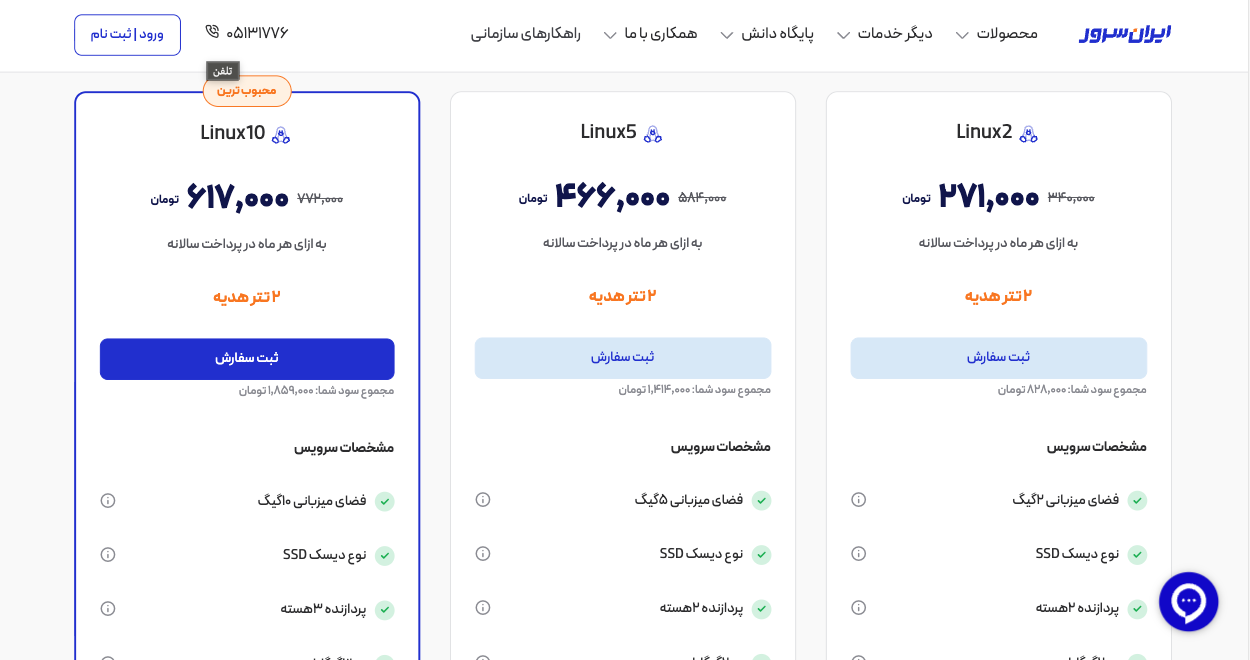
- Using a comparison table to show the differences between a product’s versions and highlighting one of the options is also a way to use upselling. For example, look at the Iran Server Linux hosting purchase page, where they’ve highlighted the linux10 plan so that newcomer customers choose it instead of the basic Linux 2 plan.
Offering at Different Stages of the Purchase
Upselling can be offered at different stages of the purchase process:
- Product page: Here you introduce the more expensive or more feature-rich version so the customer changes their mind and picks the better version. This is used on a lot of websites.
- Cart: Here the customer has already made their choice, so you can only offer adding a feature or extra service, like adding more storage in hosting plans or extending support, and similar things. For example, Jacket placed the option to add 6 more months of support on its products in this section.
- Checkout page: Here the customer has already decided and their choice is final, so it’s better not to complicate things and to collect the payment before they change their mind, then leave their choice alone. In this section we can focus on shipping methods, like offering faster delivery for an extra fee, which you can see as an example on Digikala.
Using Targeted Discounts
Offering a discount to upgrade to the Pro version is one of the effective ways to encourage customers. For example, you can offer an attractive, time-limited discount for upgrading, like 20 percent off a yearly subscription instead of a monthly one, only for the next 24 hours.
Leveraging Customer Data
Analyzing customer behavior and their previous purchase data can help you offer personalized upselling suggestions. For example, if someone previously bought a digital camera with a specific lens and now wants to buy another lens, suggest a more expensive lens that has new capabilities compared to the lens they bought before.
Common Challenges and Mistakes in Upselling
Irrelevant Suggestions
This is the most common mistake of online stores, and it even happens in many big stores. For example, when you’re on the product page for a computer CPU, a box labeled “suggested products” shows up that includes completely unrelated items like breakfast cereal, women’s underwear, a razor, and so on. This not only doesn’t help your decision, it might distract you entirely and put you off buying the product.
Too Much Pressure on the Customer
If upselling is done in a way that makes the customer feel forced, or that ruins the value of their current item, they’ll probably leave the page and give up. For example, imagine you only have the budget for a mid-range phone and the salesperson tells you this model is useless and, because of its serious problems, you’d better buy the flagship model. In that case, not only will you not buy the flagship, you’ll also skip the mid-range one and leave the store.
Caring About Your Own Profit Instead of the Customer’s Benefit
If the more expensive version doesn’t really create value for the customer, or is even lower quality than the one they picked, and you sell it to them just to increase your own profit, you’ve essentially lost that customer and destroyed your brand’s credibility in their eyes.
Conclusion
Upselling is an effective and widely used sales technique that, done right, simultaneously boosts your revenue, the customer experience, and their loyalty. To succeed at it, you need to know your customer’s needs precisely, make relevant offers, and focus on the real value of your products or services. By using this strategy, you can bring your business to sustainable growth and long-term success.