


Your business has been running for a few years, you have customers and sales aren’t bad. But if someone asked you to write on a single page exactly who your main customer is, what they pay you for, and how much is left from each order after costs, you probably couldn’t answer some of it.
The business model canvas is that page. Alexander Osterwalder designed it, and it lays out the whole business in nine blocks side by side, so you can see whether those parts fit together.
The nine blocks, and the question each one answers
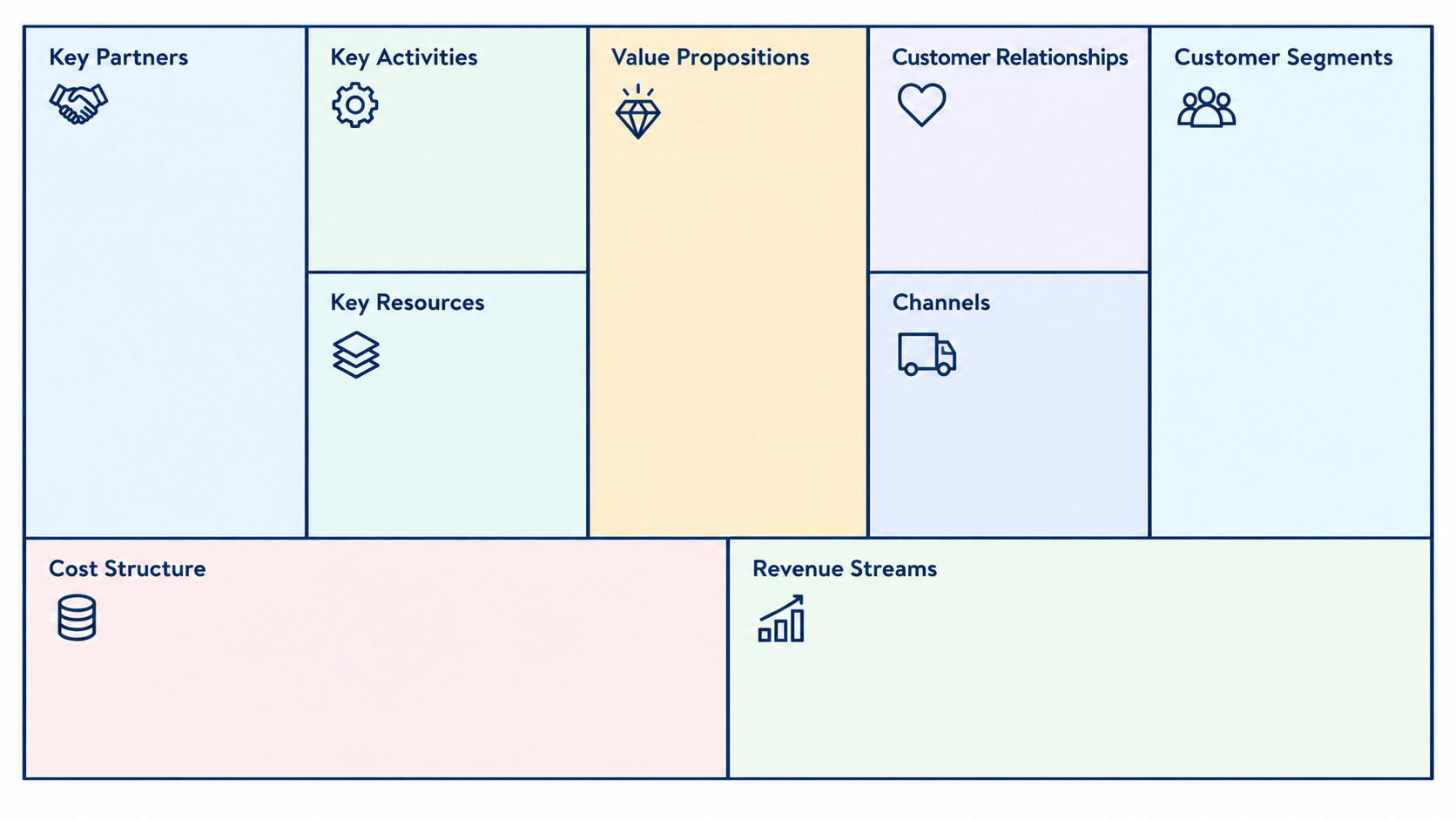
Each block on the canvas answers one question about your own business:
- Customer segments. Who exactly is your main customer.
- Value proposition. What problem the customer pays you to solve.
- Channels. Where the customer finds you, and how your product reaches them.
- Customer relationships. What you do after the first purchase so the customer comes back.
- Revenue streams. What exactly you get paid for, and how the money reaches you.
- Key resources. Which people, equipment or know-how your business can’t run without.
- Key activities. Which tasks have to happen every day for the product to reach the customer.
- Key partners. Which supplier or outside partner you depend on.
- Cost structure. Which of your costs are the biggest.
In what order should you fill in the blocks?
All you need to draw the canvas is a large sheet of paper or a whiteboard and a few sticky notes. The order you fill the blocks in matters, because if you start from the costs and resources you already have, you end up building the whole canvas around them, and what the customer actually wants gets lost.
- Start with the customer and the value proposition. Every other block exists to get this value to this customer.
- Then write down channels and customer relationships. Say where the customer finds you and how you keep them after they buy.
- Put revenue and costs side by side. See how much is left from each order once its costs are taken out.
- Finish with key resources, activities and partners. These are the things the customer never sees, but without them none of the earlier blocks happen.
Look for the blocks that don’t fit together
The real work of the canvas starts once it’s filled in. If your value proposition says your product is high quality and expensive, but your channels say most of your sales come from Instagram flash sales, those two blocks don’t fit together.
Say you run a small home bakery and you have plenty of orders, yet at the end of the month there’s nothing left in your account. Your first thought is to advertise more and sell more.
When you write revenue streams next to cost structure, you see that you sell each box of pastries for 500,000 toman, and its ingredients, packaging and courier cost 460,000. That leaves 40,000 toman per box, before you count any of your own time. The more you sell, the more you work, and the problem is the price.
Changing one block moves the others. If you raise the price some customers may leave, so after every change, check the customer block again too. In systems thinking I wrote about why every change affects the rest of your business.
When should you look at the canvas again?
Don’t draw the canvas once and put it in a drawer. Whenever you’re about to make a big decision, like adding a new product or changing your prices, look at its effect on the canvas first. These are exactly the heavy decisions I said in decision-making deserve to be taken slowly.
And if you’ve filled in your canvas but can’t tell which block has the problem, in a free diagnostic session we will go through it together.